

California’s Behavioral Health Transformation Must Include Co-treatment of Tobacco Use Disorder
Alameda County Behavioral Health Care Services developed Provider Tobacco Policies and Consumer Treatment Protocols and is a model policy for other counties
Background
California’s behavioral health system is undergoing major restructuring statewide and at the county level. In 2024, voters approved two major reforms: the Behavioral Health Infrastructure Bond Act and the Behavioral Health Services Act.1,2 Known as Behavioral Health Transformation, the initiative seeks to create a more unified and comprehensive treatment system for individuals with mental health and/or substance use disorders (SUDs).3 It reallocates funding to address homelessness and to provide critical care, with the majority invested in housing and services for the seriously mentally ill.3
This is a critical time to address deficiencies in tobacco treatment and behavioral health. The Diagnostic and Statistical Manual of Mental Illnesses (DSM-5) classifies tobacco use disorder as a SUD under the same diagnostic umbrella as alcohol, opioid, and other drug use disorders.4 Partly for that reason, Assembly Bill (AB) 541, which took effect in 2022, requires SUD facilities to assess new clients for the condition and recommend tobacco cessation in their treatment plans,5,6,7 including referral to a cessation provider such as Kick It California, the state’s free tobacco quitline.8 However, there is no formal data collection process to ensure that these requirements are met.9 Moreover, AB 541 does not apply to mental health facilities. There is also confusion about coverage, as tobacco may not be mentioned in behavioral health service codes,10 and medication costs are not covered by treatment programs but billed by dispensing pharmacies. At the same time, there are opportunities for improvement as health plans start measuring all members ages 12 and up for tobacco use and receipt of cessation interventions.11
Why Co-treating Tobacco in Behavioral Health Is So Important
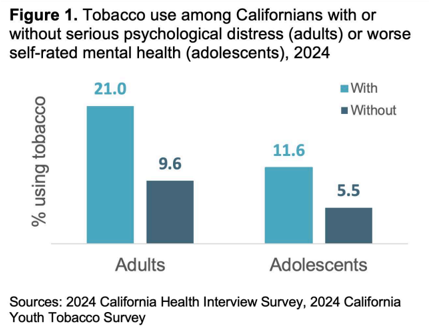
People with behavioral health conditions use tobacco at high rates. Adults and adolescents in the U.S. who report behavioral health conditions have much higher tobacco use rates than those who do not.12 As Figure 1 shows, California adults who report serious psychological distress use tobacco at more than twice the rate of those who do not,13 and adolescents who report poor mental health have double the rates of those who report good or excellent mental health.14 Despite progress in lowering tobacco use rates overall, disparities by behavioral health status persist.15
People with behavioral health conditions have a high burden of tobacco-related disease and death but may not receive tobacco treatment. The most common causes of death in this population are not behavioral health conditions, but cardiovascular disease, cancer, and respiratory diseases—all of which are caused or exacerbated by tobacco use.16 Among people with mental illness, those who smoke are twice as likely to die prematurely as those who do not smoke, and approximately half of deaths among people hospitalized for schizophrenia, depression, or bipolar disorder are from tobacco-related disease.17 Over half of people with SUDs die of tobacco-related causes, usually before age 60.18 Untreated tobacco dependence is literally killing people with behavioral health conditions.12 Yet, in 2024, only 50.4% of Californians with serious psychological distress who smoked were even advised to quit by a health care provider.13
Tobacco use worsens behavioral health conditions and interferes with treatment. Smoking can increase symptoms of depression,19 and there may be a bi-directional link between vaping and depression.20 Tobacco use acts as a mutually reinforcing gateway with cannabis use, and can increase opioid use.21,22 These factors can act as barriers to behavioral health treatment efficacy. On the other hand, quitting smoking can decrease anxiety, depression, and symptoms of stress, and can increase positive feelings, mental well-being, and possibly even social well-being.23,24 Co-treating tobacco use can increase abstinence from alcohol and other illicit substances over the long term.25,26 Screening clients for tobacco use disorder and integrating cessation services into their treatment planning therefore has great therapeutic value.
California Behavioral Health Facilities Rank Low on Tobacco Measures
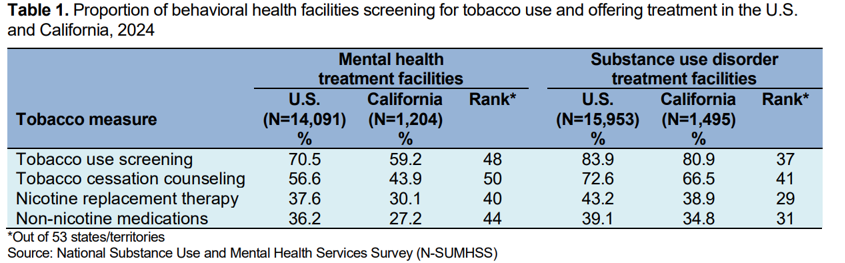
Screening and offering tobacco treatment services. California is below average in screening for tobacco use and offering cessation treatment in behavioral health settings, including outpatient mental health and SUD facilities and residential SUD facilities. As Table 1 shows, fewer than 6 in 10 mental health facilities in California screened for tobacco use in 2024, earning the state a ranking of 48th out of 53 U.S. states and territories.27 California mental health facilities also ranked low on offering cessation counseling, nicotine replacement therapy, and other cessation medications. SUD facilities did somewhat better on these measures but still ranked in the bottom half of U.S. states and territories.
Tobacco-free policy. California is also below average in implementing tobacco-free policies in behavioral health facilities—an important environment of care standard to promote health, wellness, and recovery. In 2024, only about half of California mental health facilities had tobacco-free campuses (CA 51.4%, U.S. 56.8%), and only 1 in 5 California SUD facilities had tobacco-free campuses (CA 19.6%, U.S. 27.9%).27
Support for Integrating Tobacco Cessation into Behavioral Health
Since 2007, the Smoking Cessation Leadership Center (SCLC) at the University of California San Francisco has partnered with national agencies, advocacy organizations, researchers, and states to promote the inclusion of tobacco cessation in behavioral health treatment.28,29,30 Influenced by this progress, the California Tobacco Prevention Program in 2021 set a goal of creating a norm of tobacco recovery in behavioral health systems as part of its statewide strategic plan for tobacco cessation,31 and funded the Tobacco-Free for Recovery Initiative, which has established 19 residential SUD facilities that offer tobacco treatment and have tobacco-free policies.32,33 Key national organizations have issued calls for the integration of tobacco cessation in behavioral health settings, including the American Society of Addiction Medicine (ASAM),34 the American Psychiatric Association,35 the Substance Abuse and Mental Health Services Administration (SAMHSA),36 and the Centers for Disease Control and Prevention (CDC),37 thus underscoring the importance of tobacco co-treatment.
Actions to Advance Co-treatment of Tobacco
Several actions at the county and state level would help advance co-treatment of tobacco.
What counties can do:
- Include tobacco in behavioral health plans and in Community Health Assessments (CHAs) and Community Health Improvement Plans (CHIPs). Promote multi-sector collaboration across behavioral health, physical health, and public health with the goal of providing whole person care.
- Require annual provider training and provide technical assistance on screening for tobacco use disorder and offering cessation counseling, medications, and referral.
- Adopt tobacco-free policies for behavioral health campuses to promote health and wellness. Such policies are best implemented in the context of promoting tobacco treatment and recovery.
For model language on providing comprehensive tobacco treatment, provider training and support, and tobacco-free policy, please see Alameda County’s Behavioral Health Services policy. 38
What the state can do:
- Clarify guidance in the Behavioral Health Services Act County Policy Manual39 to say that adults with co-occurring tobacco use disorder should receive co-treatment for it. Take similar action for youth and young adults in the Children and Youth Behavioral Health Initiative Fee Schedule.10
- Extend behavioral health reimbursement policies to cover co-treatment for tobacco counseling and medications.
- Require counties and Medi-Cal managed care plans to report on tobacco use and treatment for behavioral health populations. Medi-Cal managed care plans have a new quality metric to report tobacco use and cessation interventions among all members ages 12 and up. 11
- Amend AB 541 to apply its provisions to mental health facilities, and to support tobacco-free campuses in both mental health and SUD facilities. As of November 2024, six other states had tobacco treatment requirements that apply to both mental health and SUD facilities.40 As of July 2024, 18 other states and the District of Columbia required tobacco-free campuses for most mental health facilities, and 19 required them for most SUD facilities.41
- Integrate co-treatment of tobacco use disorder into California’s opiate response plan, as Washington State has done.42
The Tobacco Cessation Policy Research Center is engaging partners to include language about cotreatment of tobacco use disorder in county behavioral health plans, which are due in March 2026. Please contact us for more information.
References
- California Assembly Bill 531, Chapter 789. The Behavioral Health Infrastructure Bond Act of 2023 (2023−2024).
- California Senate Bill 326, Chapter 790. The Behavioral Health Services Act (2023−2024).
- California Department of Health Care Services. Behavioral Health Transformation overview. 2024.
- American Psychiatric Association. Diagnostic and Statistical Manual of Mental Disorders. 5th ed. 2013.
- California Assembly Bill 541, Chapter 150 (Health and Safety Code Section 11756.5).
- California Department of Public Health, California Tobacco Control Program. Understanding Assembly Bill (AB) 541: assessment of tobacco use disorder in substance use disorder recovery or treatment facilities. 20227
- California Department of Health Care Services. Behavioral Health Information Notice No: 22-024. 2022.
- Kick It California. AB 541: helping tobacco users in substance use treatment. 2024.
- California Department of Health Care Services. Client health questionnaire and initial screening questions. 2022.
- California Department of Health Care Services. Children and Youth Behavioral Health Initiative (CYBHI) Fee Schedule Program. 2025.
- Kolinski B. Tobacco cessation HEDIS measure planned for MY 2026. 2025.
- Loretan CG, Wang TW, Watson CV, Jamal A. Disparities in current cigarette smoking among US adults with mental health conditions. Prev Chronic Dis. 2022;19:E87.
- UCLA Center for Health Policy Research. AskCHIS: California Health Interview Survey [Data set].
- California Tobacco Prevention Program. Tobacco and cannabis use among California youth by general mental health. 2024.
- U.S. Department of Health and Human Services. Eliminating tobacco-related disease and death: addressing disparities—a report of the Surgeon General. Atlanta, GA: U.S. Department of Health and Human Services, Centers for Disease Control and Prevention, National Center for Chronic Disease Prevention and Health Promotion, Office on Smoking and Health, 2024.
- Druss BG, Zhao L, Von Esenwein S, et al. Understanding excess mortality in persons with mental illness: 17-year follow up of a nationally representative US survey. Med Care. 2011;49(6):599−604.
- 17 Tam J, Warner KE, Meza R. Smoking and the reduced life expectancy of individuals with serious mental illness. Am J Prev Med. 2016;51(6):958−966.
- Bandiera FC, Anteneh B, Le T, et al. Tobacco-related mortality among persons with mental health and substance abuse problems. PLoS One. 2015;10(3):e0120581.
- Boden JM, Fergusson DM, Horwood LJ. Cigarette smoking and depression: tests of causal linkages using a longitudinal birth cohort. Br J Psychiatry. 2010;196(6):440−446.
- Ji S, Chen L, Zhuang S, et al. Bidirectional association between e-cigarette use and depression: a meta-analysis. Nicotine Tob Res. Published online August 6, 2025.
- Badiani A, Boden JM, De Pirro S, et al. Tobacco smoking and cannabis use in a longitudinal birth cohort: evidence of reciprocal causal relationships. Drug Alcohol Depend. 2015;150:69−76.
- Morris CD, Garver-Apgar CE. Nicotine and opioids: a call for co-treatment as the standard of care. J Behav Health Serv Res. 2020;47(4):601−613.
- Taylor GM, Lindson N, Farley A, et al. Smoking cessation for improving mental health. Cochrane Database Syst Rev. 2021;3(3):CD013522.
- Martínez-Vispo C, Rodríguez-Cano R, López-Durán A, et al. Cognitive-behavioral treatment with behavioral activation for smoking cessation: randomized controlled trial. PLoS One. 2019;14(4):e0214252.
- Prochaska JJ, Delucchi K, Hall SM. A meta-analysis of smoking cessation interventions with individuals in substance abuse treatment or recovery. J Consult Clin Psychol. 2004;72(6):1144−1156.
- McKelvey K, Thrul J, Ramo D. Impact of quitting smoking and smoking cessation treatment on substance use outcomes: an updated and narrative review. Addict Behav. 2017;65:161−170.
- 27 Substance Abuse and Mental Health Services Administration. National Substance Use and Mental Health Services Survey (N-SUMHSS) State Profiles: National and State Highlights 2024. 2025.
- Schroeder SA, Morris CD. Confronting a neglected epidemic: tobacco cessation for persons with mental illnesses and substance abuse problems. Annu Rev Public Health. 2010;31:297−314.
- Schroeder SA, Clark B, Cheng C, Saucedo CB. Helping smokers quit: the Smoking Cessation Leadership Center engages behavioral health by challenging old myths and traditions. J Psychoactive Drugs. 2018;50(2):151−158.
- Vijayaraghavan M, Bonniot C, Satterfield J, et al. State Leadership Academies to reduce cigarette smoking among people with behavioral health conditions in the United States. Prev Med Rep. 2024;47:102896.
- California Department of Public Health, California Tobacco Control Program. California quits together: creating a tobacco-free future. 2021
- McCuistian C, Kapiteni K, Le T, et al. Reducing tobacco use in substance use treatment: an intervention to promote tobacco-free grounds. J Subst Abuse Treat. 2022;135:108640.
- McCuistian C, Lisha NE, Campbell B, et al. Reducing tobacco use in substance use treatment: the California tobacco free initiative. Addict Behav. 2024;155:108025.
- American Society of Addiction Medicine (ASAM). Integrating tobacco use disorder interventions in addiction treatment: a guide for addiction treatment clinicians and programs. 2025.
- American Psychiatric Association. Position statement on tobacco use disorder. 2015.
- Substance Abuseand Mental Health Services Administration Implementing tobacco cessation programs in substance use disorder treatment settings: a quick guide for program directors and clinicians. 2018.
- Centers for Disease Control and Prevention (CDC), Office on Smoking and Health. Promising policies and practices to address tobacco use by persons with mental and substance use disorders. 2018.
- Alameda County Behavioral Health Care Services. Provider tobacco policies and consumer treatment protocols. 2016.
- California Department of Health Care Services. Behavioral Health Services Act county policy manual. 2025.
- Public Health Law Center. U.S. state laws requiring mental health and substance use facilities to provide tobacco dependency treatment in clinical practice. 2024.
- Public Health Law Center. U.S. state laws requiring tobacco-free grounds for mental health and substance use facilities. 2024.
- Washington State Department of Health. Tobacco-Free Behavioral Health Initiative (TFBHI).
Click here for a printable version of the Policy Brief on Behavioral Health and Tobacco
Alameda County Behavioral Health Care Services developed Provider Tobacco Policies and Consumer Treatment Protocols and is a model policy for other counties
Contact us
- [email protected]
- https://tcprc.ucdavis.edu
- TCPRC is a community-academic research partnership housed at the UC Davis Comprehensive Cancer Center. Funded by the Tobacco-Related Disease Research Program, grant #T33PC6880.
Last updated Dec. 11, 2025