

Sacramento’s “Healthy Food Exemption” Increases Tobacco Inequities but not Healthy Food Access
Background
As of 2025, the City of Sacramento had 325 tobacco retailers,1 roughly 55% more (115 retailers) than recommended by the Public Health Law Center for tobacco retailer density.2
Sacramento’s Healthy Food Exemption (HFE; Sacramento City Code 5.138.040 subsection (B)) is a 2020 amendment allowing retailers devoting ≤5% of total shelf space to tobacco and ≥10% of total shelf space to “healthy” foods to bypass tobacco retail density restrictions.3,4 The HFE requires retailers to stock 5 categories of healthy foods, including fresh fruits and vegetables, but also considers nutritionally unhealthy products (hot dogs, pepperoni pizza, & doughnuts) to be “healthy” foods.5
The HFE increased tobacco retail availability in Sacramento. As of February 2025, 33 tobacco retailers used the HFE which accounted for 45% of all new Tobacco Retail Licenses issued after 2020. HFE retailers opened in all 8 Districts, with the majority District 2 (30%), District 4 (15%), and District 6 (15%).
Healthy Food Exemption Categories
- Fresh or healthy food
- Fresh fruits or vegetables
- Juice and dairy products
- Meat, fish, or poultry
- Fresh baked goods, breads, and cereals
Activities
- Researchers at UC Davis partnered with The SOL Project and conducted in-store observations between September and October 2025 to determine if tobacco retailers using the HFE stock healthy foods in compliance with the exemption. We used HFE retailer location data provided by the City of Sacramento Code and Housing Enforcement in February 2025.
- To identify place-based inequities in where retailers using the HFE opened, we used data from the USDA Food Access Research Atlas (formerly the Food Desert Locator) and the 2020-2024 American Community Survey (ACS) 5-year estimates to compare demographics in the census tracts where HFE retailers opened to the Sacramento County average.
- To investigate the origin of the HFE, including potential industry influence, we conducted a content analysis of Sacramento City Council Agendas and Meeting Minutes from 2019-2025.
Findings
Retail Store Observations
Of the 33 retailers that used the Healthy Food Exemption to open, 2 were permanently closed, 1 was unsafe for in-store observation, and 1 did not sell tobacco or food. We conducted store observations in 29 stores that used the Healthy Food Exemption.
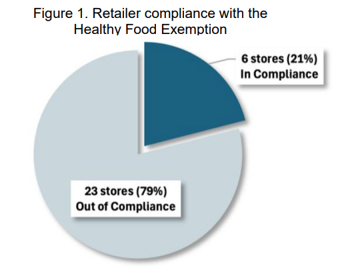
Only 6 retailers (21%) were in compliance with the foods required by the Healthy Food Exemption (Figure 1).
Noncompliance was largely driven by a lack of fresh fruits and vegetables, only 12 retailers (41%) had fresh fruit and only 6 retailers (21%) had fresh vegetables.
Even retailers that stocked fresh fruits and vegetables often had limited or low-quality options (Figure 2).
Large sections of the HFE retailers were devoted to unhealthy products like tobacco, alcohol, and sugary drinks (Figure 3).

Place-Based Inequities & TRL Transferability
Only 2 of 33 HFE retailers (6%) opened in “Low Income and Low Access” areas, a proxy for “food deserts.” USDA defines these areas as a significant number or share of residents that are >1 mile in urban areas or >10 miles in rural areas from the nearest supermarket.
HFE retailers opened in areas with larger Black and Hispanic populations, and areas with lower educational attainment and income, compared to Sacramento County on average (Table 1).
Table 1. Average demographics in HFE retailer census tracts and Sacramento County. Source: 2020-2024 American Community Survey (ACS) 5-year estimates.
HFE retailer census tracts average | Sacramento County average | |
| % Non-Hispanic Black | 21.1% | 9.0% |
| % Hispanic | 35.3% | 24.2% |
| % of 25+ year olds w/ a bachelor's degree or higher | 34.7% | 42.4% |
| Median household income | $71,117 | $92,175 |
Together, these place-based findings indicate that the HFE did not result in food retailers opening in food deserts.
Instead, the HFE did result in tobacco retailers opening in areas that often already have greater tobacco and alcohol retailer availability6,7 and rates of tobacco use.8
Transferability of these HFE TRLs would continue to exacerbate the excessive TRLs and promote greater health inequities.
Healthy Food Exemption Origins
Sacramento City Council Agendas and Meeting Minutes from 2019 to 2025 indicate potential tobacco and retail industry influence in the original passage of the HFE. In February 2019, Sacramento City Staff met with representatives from JUUL (the electronic cigarette manufacturer), the American Petroleum and Convenience Store Association, and the California Fuels and Convenience Alliance to discuss tobacco retailer density in Sacramento. Furthermore, the HFE policy language that was adopted in October 2020 was first “submitted/drafted by a stakeholder,” but the stakeholder is not identified in City Council Meeting Minutes.
References
- Stanford CTHAT. Accessed March 20, 2026. https://cthat.org/?#COMPREHENSIVE TOBACCO RETAILER LICENSING Model Ordinance.
- Public Health Law Center at Mitchell Hamline School of Law; 2026. Accessed March 20, 2026. https://www.publichealthlawcenter.org/sites/default/files/resources/TRL-Model-Ordinance-NYS.pdf
- Healthy Food Exemption - Sacramento City Code 5.138.040. Accessed March 9, 2026. https://www.cityofsacramento.gov/communitydevelopment/code-compliance/business/tobacco/healthy-food-exemption
- 5.138.040 Requirement for tobacco retailer license. American Legal Publishing. Accessed March 9, 2026. https://codelibrary.amlegal.com/codes/sacramentoca/latest/sacramento_ca/0-0-0-14928
- Sample list of products. Accessed March 13, 2026. https://www.cityofsacramento.gov/content/dam/portal/cdd/CodeCompliance/Business/Example_List-of-Produce.pdf
- Kong AY, et al. (2021). Sociodemographic inequities in tobacco retailer density: Do neighboring places matter?. Health & place, 71, 102653.
- Kong AY, et al. (2023). Tobacco and alcohol retailer availability and neighborhood racialized, economic, and racialized economic segregation in North Carolina. Journal of racial and ethnic health disparities, 10(6), 2861-2871.
- Leas EC, et al. (2019). Place-Based inequity in smoking prevalence in the largest cities in the United States. JAMA Int Med, 179(3), 442-444.
Contact Us:
- [email protected]
- [email protected]; https://tcprc.ucdavis.edu
- [email protected]; https://thesolproject.com
- TCPRC is a community-academic research partnership housed at the UC Davis Comprehensive Cancer Center.
Funded by the Tobacco-Related Disease Research Program T33PC6880
Click here for a printable version of the Policy Brief on Sacramento's "Healthy Food Exemption"